The Field
What You Win When You Win
Every DraftKings lobby has them, the contests with the banner. ONE MILLION DOLLARS TO FIRST. You’ve imagined it — everyone has. The leaderboard refresh, your name at the top, the seven-figure payout hitting your account.
Across the past four NFL seasons, my data holds twenty-four large-field showdown contests that hung that banner. What did finishing first in them actually pay?
How a tie splits the check
First, the mechanics, because they decide everything. When entries tie on DraftKings, they pool the prizes for the positions they occupy and split the pool evenly. Say a contest pays $100, $50, $25 for the top three, and three entries tie for first. Nobody gets $100. Each gets a third of $175, $58 and change. The advertised first prize exists only if exactly one entry holds it.
Now connect that to the menu count from the last lesson. A showdown field of half a million entries collapses into a few tens of thousands of real lineups, so at every score on the leaderboard, including the very top one, there’s usually a crowd on the same number. Identical roster, identical score, identical rank. The tie is the last lesson’s compression showing up at the worst possible spot on the leaderboard.
The two games, again
Intuition says a tie at the very top should be a freak event. One big lottery, one exact best score, and the odds of two people landing on it feel microscopic.
I measured it across 756 of the same 771 large-field contests from the last lesson, fifty thousand entries and up. (The small-field, single-entry world is a different economy. I’ll flag it whenever we’re there.)
In classic, your intuition is exactly right. 94.5% of contests paid an outright first, and the deepest first-place tie in four seasons was six entries. If you win a big classic tournament, the banner is basically yours.
In showdown, your intuition is wrecked on arrival. The banner pays in full about one time in five. The other four, the top of the leaderboard is a tie, the median one nine entries deep, the deepest one 287. And when the biggest banners split, they split hard:
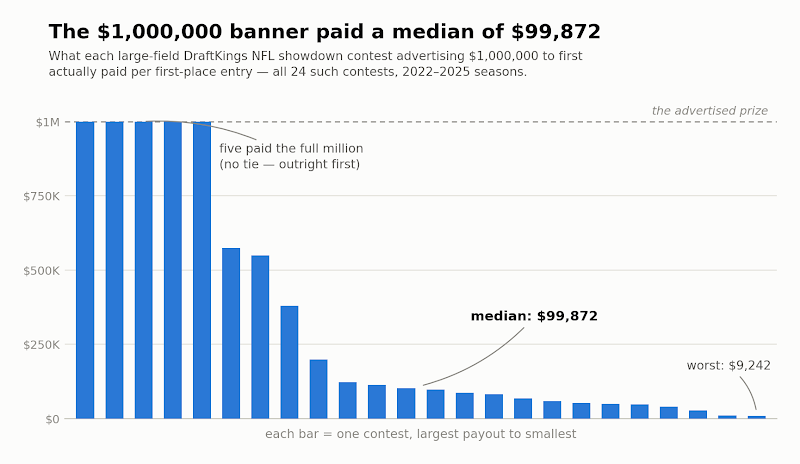
The most famous number in DFS, the million-dollar first prize, has been collected in full five times in four years of showdown. The median winner of that banner took home about a tenth of it. The unluckiest clean case in the data was a $500,000 banner that paid $3,574 per winning entry, a 218-way handshake at the top of the mountain.
Pricing the banner
The answer to “what do you win when you win?” is that it depends on how many of you there are. After the last lesson, you know that number is large and predictable in showdown, small and ignorable in full-slate classic.
Which means the advertised prize is an upper bound. The real quantity, the one worth doing arithmetic on before you enter, is the banner divided by the crowd you’d share it with, and that divisor is a function of duplication, which you can estimate before lock. Later in this course, you’ll see that two lineups with the same projection can carry completely different divisors, and that you can know which is which in advance.
Until then, one habit change. When a showdown lobby shows you a first-place number, see it with a silent asterisk — up to. The banner is a ceiling, not a promise, and now you know how often the ceiling actually gets touched, about one time in five.
Up next: where the crowding comes from in the first place. Ownership, and the strangely predictable way a hundred thousand strangers, all acting independently, keep arriving at the same handful of players.
Going deeper: who’s actually in the tie with you?
Two wrinkles the mechanics hide. First, the split runs deeper than first place. If 28 entries tie at the top, they pool the prizes for positions 1 through 28, so the size of your check depends not just on the tie count but on how steeply the payout curve falls beneath you. Top-heavy structures soften big ties. Flat ones make them brutal. Second, in mass multi-entry contests, “28 entries” is not “28 people.” One entrant holding three copies of the winning roster collects three shares of the split, which means a sharp mass-entry player who knows a roster will be heavily duplicated can still profit from it by owning the duplication rather than avoiding it. Hold that thought. It becomes a strategy question later in this course.