The Field
Duplication Is a Price
In a 158,000-entry showdown contest in my data, one roster was submitted 3,567 times. Three and a half thousand entries, at least 179 different players, walking to the window with the same ticket. Whatever that lineup was going to win, every one of them had agreed, before kickoff and without knowing it, to split the check 3,567 ways. That’s the cost the last lesson named, and it’s the biggest case of it I’ve found. This lesson is about reading your own before you submit.
One number reads the price
Take any lineup and add up its players’ ownership, six numbers in showdown, nine in classic (in showdown, count the captain slot at his captain-ownership, since captaining a player is its own, rarer bet). That’s the lineup’s cumulative ownership. No projections, no salaries, nothing clever. Just how much of the crowd you’re standing with, summed.
I scored all 113 million entries this way, sorted each game type into ten equal buckets from least chalky to chalkiest, and asked one question per bucket: how many copies of each lineup exist in its contest (counting itself, so a count of one means nobody else has it). The natural guess is that copies rise smoothly as the total climbs, a meter that ticks up as you get chalkier. That is not what the data says, and the two games fail the guess in opposite ways.
A cliff and a certainty
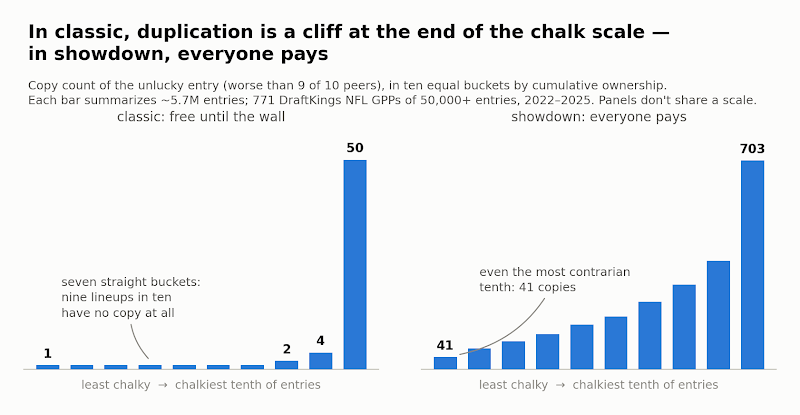
In classic, the first seven buckets (70% of everything ever submitted) read almost blank. About nine lineups in ten are the only copy of themselves in their contest, and most of the rest have just a twin or two. Get chalkier and the count starts to creep. Then the last bucket is a wall. The typical lineup in the chalkiest tenth shares its contest with two identical twins, one in ten of them is in a crowd of fifty, and only a third are still one of a kind. Classic doesn’t charge for chalk by the pound. The scale reads zero nearly the whole way up, then charges everything at once at the top.
Showdown fails the guess from the other side. The least chalky tenth of showdown entries (the most contrarian builds in 57 million) still averages 17 copies. The chalkiest tenth averages 279, and that’s where the 3,567 sits. There is hardly ever a showdown build that is rare. You never choose whether to split the check in showdown, only with how many hands.
Reading yours before lock
The one-minute check before you submit is to add up your lineup’s projected ownerships and place yourself on the scale. In classic the free zone is wide. Totals up to about 150% carry essentially no duplication, and seven in ten classic entries sit there. From 150% to 200% the meter finally starts ticking, gently. The wall stands at 200%. Past it you’re in the bucket where twins are standard and the unlucky share with fifty. In showdown the scale starts above where classic’s ends. Below a total of about 170% you’re with a handful, sometimes dozens, and past 250% with hundreds.
One limit. I measured this with ownership as it settled, and before lock you only have ownership as it’s projected. That’s enough to know your zone. It won’t call your exact copy count.
And I haven’t told you which zone is best. Cheap is not the same thing as valuable. Knowing that the crowded end splits its winnings hundreds of ways makes buying the empty end feel obvious. That idea is called leverage, and an entire genre of DFS content is built on it, including rules of thumb about the “right” total ownership. Next lesson I stop guessing and count what leverage actually paid.