The Field
The Field Is Smaller Than It Looks
It’s 7:58 on a Sunday night. You’ve spent twenty minutes building your NFL showdown lineup for the 8:20 game — juggled the salaries, talked yourself out of the kicker twice, settled on the captain you swore you wouldn’t play. It’s a clever little lineup and it is yours. So here’s a bet, before lock: in a contest with 474,000 entries, how many other people are holding exactly your six players, in exactly your configuration?
Take a second. Write your number down.
Counting the menu
Most people reason it this way. A DFS lineup is a needle in a combinatorial haystack. In a classic Sunday contest you’re choosing nine players from hundreds, and sure, nobody builds a lineup at half the salary cap, but even the sliver of that space people actually play, near-cap and sensibly constructed, should be bigger than any crowd that shows up to fill it. Duplicates should be rare, then. Freak events. And a showdown lineup reads like a smaller version of the same thing. Fewer slots, fewer players, same basic story.
Count the menu. On a one-game showdown slate there are maybe eighteen players a sane person would roster, once you cross out the fourth wideout and the backup tight end. You pick one captain and five others: about a hundred and ten thousand combinations, before the salary cap starts crossing entrées off the menu, and the cap is ruthless. Then remember that everyone at the table is reading the same injury news, the same projections, the same three touts. Four hundred seventy-four thousand diners. A menu with, being generous, a few tens of thousands of plausible meals.
You may want to revise your number.
So I counted
Not estimated — counted, across 771 large-field DraftKings NFL contests from 2022 through 2025. A hundred and thirteen million entries, every roster in every one of them.
The largest showdown contest in that pile had 474,300 entries. It contained 35,935 different lineups (7.6%). One truly distinct lineup for every thirteen entries. In that contest, being the only copy of your roster put you in a club of roughly one entry in thirty, and the most popular single roster was submitted 1,566 times. Somewhere out there, 1,566 entries all arrived at the party in the same powder-blue tuxedo and top hat.
I expected some version of that. Here’s what I didn’t. A classic contest of the same size (494,926 entries, full Sunday slate) held 465,471 distinct lineups. Ninety-four percent. The folk belief says big fields are sure to have many duplicates. The data says a half-million-entry classic field is almost entirely one-of-a-kind lineups, and that it’s the small games that collapse. Duplication was never about how many people showed up. It’s about how big the menu is.
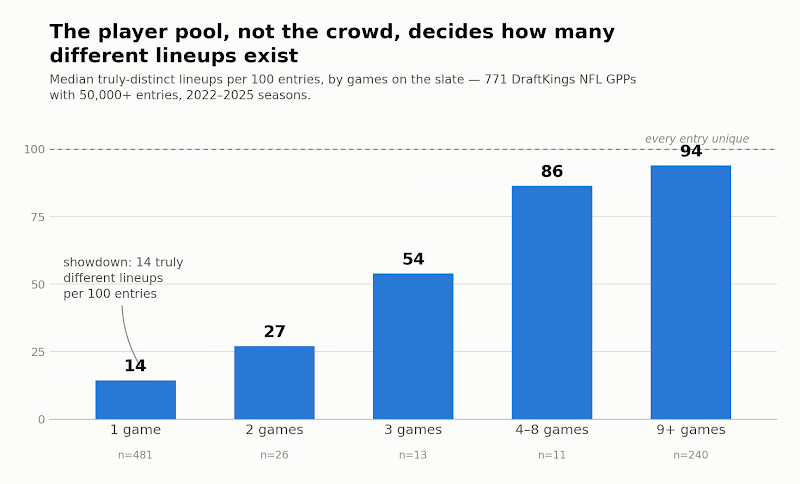
The ladder only moves one way. One-game slates, 14 distinct lineups per hundred entries. Two games, 27. Three, 54. A full Sunday, 94. And field size barely budges these numbers in classic. In showdown, bigger fields do compress it, 17 truly different per hundred down to 8, but the gap to classic never closes. My favorite detail in the whole dataset is the single biggest classic contest of these four seasons, a 593,000-entry monster that came in at just 47 percent distinct, because it ran on a three-game holiday slate. A classic contest acting like a showdown, and it behaved exactly the way the menu said it would.
Which field are you actually in?
Pooled across everything I counted, in classic 85 of every 100 entries are the only copy of their lineup. In showdown, six are, and a copy is the normal case. The typical showdown entry sits on a roster that already exists dozens of times over in the same contest.
The first thing to know about the field, then, is which field you’re in. In classic, uniqueness is the default. You get it nearly for free. In showdown, uniqueness is scarce, and “I’ll just build something different” runs straight into the arithmetic of an eighteen-player menu. Different how, exactly, when across every showdown contest I counted there are seven entries for every real lineup, and thirteen in that 474,000-entry contest. What a copy actually costs you at the payout window, and when paying that cost is completely fine, is where this course goes next.
For now, go back to the number you wrote down before lock. If you guessed zero, you’re probably a classic player. If you guessed zero and you play showdown — somewhere between a few dozen and fifteen hundred people would like a word about the tuxedo.
Up next: what all those shared lineups do to the prize money. A crowd holding the same roster is holding the same check, and “first place” rarely means what the lobby says it does.
Going deeper: what counts as “the same lineup”?
Two subtleties in the counting, both bigger than you’d guess. First, the captain. A showdown roster is six names, but the same six names with a different captain is a genuinely different lineup. It scores differently, costs differently, wins differently. Count six-name groups instead of captained rosters and that 35,935 collapses to 19,892, so the captain choice alone accounts for nearly half of all the distinctness showdown has. Second, slot shuffles. In classic, the same nine players can be stored in different slot arrangements, whoever you happened to park in FLEX. Raw site data counts those as different lineups. I collapse them, because they’re the same bet wearing different name tags. In that 593K holiday contest, the collapse removed 62,561 phantom “unique” lineups, eighteen percent of the raw count.