Drafter’s Strategy: Positional Silos
WRITTEN BY: MIKE JOHNSON (@MJOHNSON_86)
Now that we know what our target is (2,800 points), the question becomes; “how do we get there?” This is where our deep dive into this format really gets going as we must think of these contests far differently than the playoff formats on Underdog and Draftkings.
On those other sites, the goal is simply to survive the first 14 weeks with an above average lineup that beats at least 10 of the other 11 teams in your drafting pod. Once you have accomplished that, the goal is to have high ceiling (and ideally healthy) players, with some correlation mixed in to maximize weekly upside as these individual weeks have far greater importance than the first 14 weeks and ultimately determine whether you are profitable or not. There is an element of “pod luck” involved in those contests as well (for example, one team could score 160 points in Week 15 and win their pod/group while another team could score 190 points and finish second or third in theirs), which is out of our control. In the simplest of terms, the goal in those contests is to be good for the majority of the season and then have maximum single week upside within your roster for the stretch run and hope for the best. There are a lot of strategies and concepts that can be taken for that format, but many of those are irrelevant or far less optimal in the cumulative scoring format.
With all of that in mind, the next thing we must acknowledge and understand is that scoring for all of the weeks is equally important and that having a high scoring week in any given week doesn’t really carry any added weight. Therefore, how should we be looking to build our rosters? If the “traditional” Best Ball formats encourage focusing on weekly scoring that isn’t as valuable in this format, then on Drafters we should be flipping the way we look at things. I do that through the lens of a concept I call “Positional Silos”. To help you understand what I mean, below are two visuals that help to explain things. The visuals are grids depicting the 17 weeks of the Best Ball season and the eight positions that count towards your score each week. The first shows how most people view Best Ball, through a horizontal/weekly perspective (highlighted in yellow and green). The second shows how we SHOULD view things, through a positional/vertical perspective.
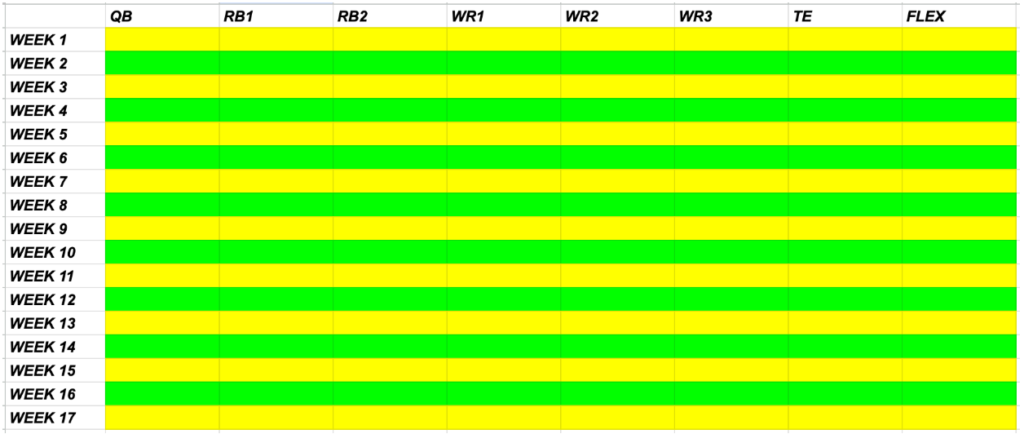
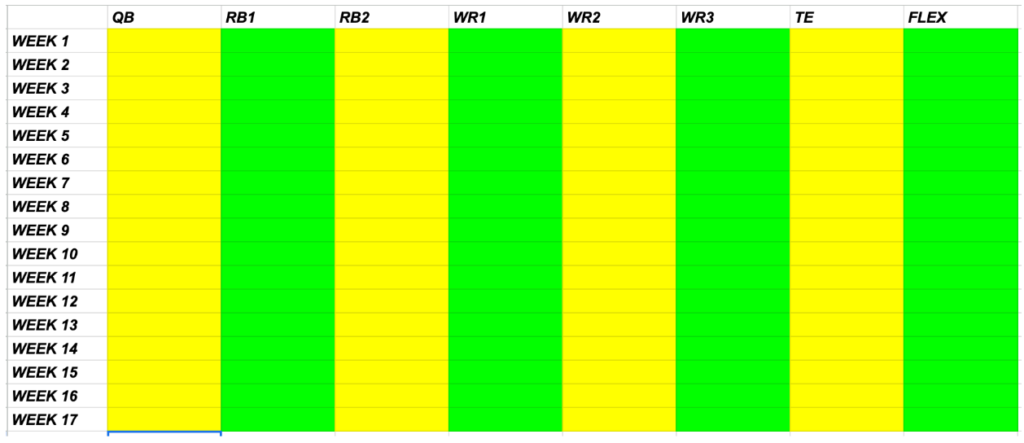
The reason that we should view things through the “Positional Silos” perspective rather than the weekly perspective is simply control. As discussed earlier, a high score in any individual week is irrelevant and over the course of 17 weeks everything tends to even out. It is impossible to plot out things from a weekly basis, and how things come together in that regard is just out of our control (similar to “pod luck” in the other format). What we DO have control over is how we construct our rosters and understanding the historical relationships between ADP’s at the various positions and final results in terms of positional rankings and optimal draft capital allocations.
Now we know that 2,800 points is our target. And we know that we should be looking at things from a “Positional Silos” perspective. So what does that mean? Well, there are eight positions that count towards our score weekly. So we can simply divide 2,800 by 8, which gives us 350 points. This means that we are looking to have each silo contribute 350 points. Obviously, that is not going to be evenly distributed (the WR1 position will obviously score much higher than the WR3 position), but seeing things from that perspective helps us to understand how we are constructing our lineups. Likewise, our target for the QB position is generally around the 400 point range (we will get into this in the QB chapter), while if you are able to get around 300 points from the TE position you are in really good shape. So the targets for each specific “position” may vary, but we should operate with that in mind – that 350 points per silo is the overall target for 17 weeks.
Side Note: While we look at things from the perspective of “Positional Silos” with eight positions in mind, it may be helpful at the RB and WR positions to look at things from the perspective of one bigger silo rather than multiple individual ones. So for the RB position, a wider “silo” of two positions that we are targeting 700 points from across the 17 weeks (so 34 total scores from the RB positions). The same for WR, where the “target” would be 1,050 points in total from the three WR slots (51 total scores).
If you want to take this thought process a step further, we can divide the 350 points per silo by the 17 week season (350/17). This gives us 20.6 points per week from each of your eight positions as your target. Again, we don’t expect to have eight players score 20.6 points each week and it will normalize itself across the season, but knowing that number is critical because it can keep you from something that I think many people do incorrectly – which is placing too much value on “steady” or “consistent” players who lack weekly upside. This leads us to the next critical concept that we must understand in order to optimize our Drafters rosters: “Usable Weeks // Points Added”.